One Agency for Branding, Web Design, SEO and Signage: Horizium
A business undergoing a rebrand, launching a new company or opening new premises can quickly find itself coordinating several different specialists. A branding agency develops the identity, a web design agency interprets it online, an SEO specialist works on visibility, while signage and interior branding may be commissioned separately once the physical environment is ready. Each supplier may be highly capable within its own discipline, but the responsibility for connecting those decisions often remains with the client.
Horizium has developed around a different model. We bring together branding, web design, digital and SEO, interior branding and visual experiences within one creative structure, allowing us to consider how an organisation is positioned, how people discover it, how they interact with it digitally and how the same brand is experienced in physical environments.
The purpose is not simply to provide more services from one agency. It is to maintain continuity between disciplines that increasingly influence one another and that customers already experience as parts of the same business.
Why Horizium Brings Digital and Physical Branding Together
The separation between branding, digital and physical design largely reflects how creative industries developed rather than how customers actually experience businesses. Different specialist industries emerged around graphic design, website development, search marketing, signage and interior environments, so organisations became accustomed to commissioning them independently.
Customer journeys rarely respect those boundaries.
A potential client might discover a company through Google or an AI-generated search result, visit its website, check reviews and social media, arrange a meeting and eventually walk into its office. Another may encounter the business at an exhibition before searching for it online later that evening. Every interaction contributes towards the same judgement about credibility, relevance and quality.
This creates practical relationships between disciplines. Positioning determines what a website communicates. Website architecture affects search visibility. Brand identity needs to function across both small screens and large physical environments. Signage, interiors and exhibitions need to reinforce expectations that may have been established digitally weeks earlier.
Horizium’s integrated model is built around managing those relationships rather than treating each deliverable as an isolated project.
Brand Identity Has to Work Beyond the Brand Guidelines
Branding often provides the foundation because decisions made during identity development eventually influence almost everything else. Typography, colour, imagery, graphic systems and messaging need sufficient flexibility to work across websites, marketing communications and physical environments without losing recognition.
Consider a company undergoing a complete repositioning. A visual identity developed only around presentations and social media may look impressive initially, but problems can emerge when the same typography needs to appear on external signage or when the graphic system needs to accommodate hundreds of website pages. Resolving those limitations later usually means compromising the identity or redesigning parts of it.
Horizium can consider those applications during development. A brand system can be evaluated against website interfaces, content requirements, signage legibility and environmental applications before the business begins rolling it out.
That creates a more useful brand identity. Instead of producing a collection of assets followed by a handover, the identity becomes a working system capable of supporting the organisation as it develops.
Web Design and SEO Need to Influence Each Other Earlier
The relationship between web design and SEO provides another practical example of where integration matters.
Imagine an established business replacing a website that already generates organic enquiries. A web agency could successfully redesign it from a visual and user experience perspective while inadvertently changing valuable URLs, removing established landing pages or creating a navigation structure that no longer reflects how customers search. An SEO specialist brought in after launch would then be repairing decisions that could have been considered during planning.
Horizium approaches website architecture with both users and search visibility in mind. Existing organic performance can be reviewed before structural decisions are made, while keyword research and customer search behaviour can help identify which services, locations and questions deserve dedicated content.
Creative design remains important, but it develops within a structure that also needs to perform commercially.
For a new business, the same principle works in reverse. Search research can reveal how potential customers describe services before the website architecture has been finalised, allowing the site to develop around genuine demand rather than internal terminology alone.
SEO Now Includes How Machines Understand the Brand
Search optimisation itself is also becoming broader. Google Search, local results, AI Overviews and other AI-assisted discovery systems increasingly interpret relationships between businesses, services, locations, people and subjects rather than relying solely on individual keywords.
This makes brand clarity increasingly relevant to machine readability.
Horizium’s approach can include conventional technical and on-page SEO alongside entity-based optimisation, structured data, internal linking, topical content architecture and consistent business information. For organisations serving specific geographic markets, local signals such as location content, Google Business Profile information, relevant citations and customer reviews can also strengthen the relationship between the organisation, its services and the places it serves.
Consider a specialist business operating from Chelmsford while serving clients throughout London and Essex. Simply repeating those locations throughout website copy would provide limited value. A stronger approach establishes genuine relationships through appropriate service architecture, project evidence, local business information, relevant content and consistent external signals.
The same principle increasingly applies to AI search. Machine systems need enough context to determine what an organisation does and when it is relevant. Clear positioning therefore supports both human understanding and digital discoverability.
Physical Branding Continues the Experience Beyond the Screen
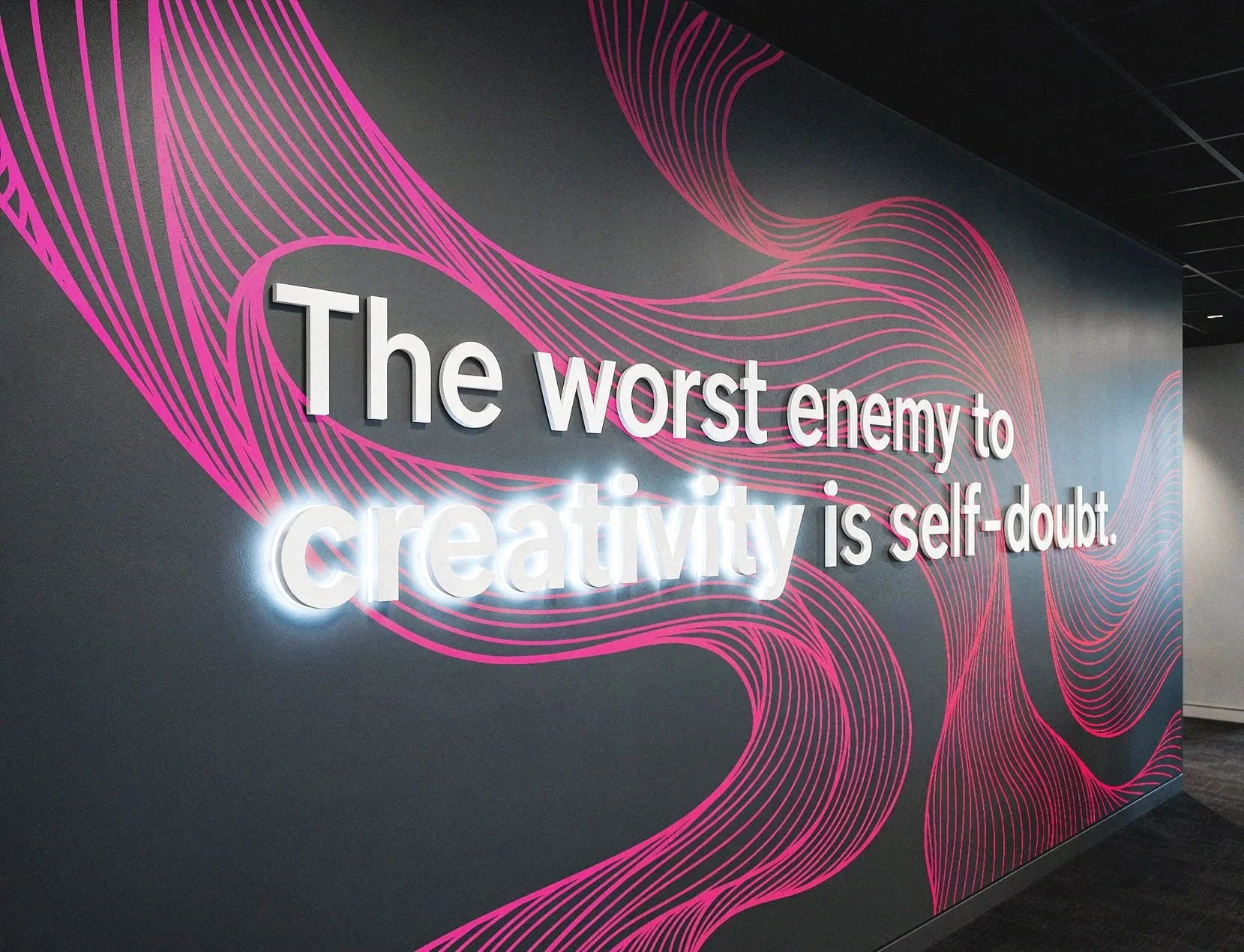
A business can invest significantly in branding, search visibility and a sophisticated website, only for the customer to encounter a completely different impression when arriving at its physical premises.
Interior branding and signage address that transition.
For example, a professional services company may communicate precision and contemporary thinking online. Its reception environment can reinforce those qualities through considered signage, typography, materials, environmental graphics and wayfinding rather than simply placing the company logo behind the reception desk.
Physical branding also introduces requirements that do not exist digitally. Viewing distance, scale, lighting, architectural surfaces, materials, accessibility and visitor movement can all influence how a design performs.
By considering physical applications within the wider brand system, Horizium can develop environments that respond appropriately to those conditions while remaining recognisable as the same organisation customers encountered online.
From Creative Direction to Professional Implementation
Creating effective signage, interior branding and environmental graphics requires more than strong creative direction. Materials, manufacturing methods, site conditions, installation requirements, durability and finishing quality can all determine how successfully a design translates into a physical environment.
Horizium works with a trusted network of specialist signage manufacturers, production providers and professional installers, selected according to the technical requirements of each project. This allows us to coordinate the journey from brand concept and environmental design through to production and installation while maintaining consistency with the wider visual identity.
Whether the project involves office signage, branded interiors, wall graphics, wayfinding, retail displays or exhibition environments, specialist manufacturing expertise supports the practical delivery behind the creative work. For clients, this provides a professionally managed route from initial design to finished physical implementation, with creative and technical decisions considered as connected parts of the same project.
Visual Experiences Need to Communicate Quickly
Exhibitions, retail displays and temporary brand environments introduce another type of challenge. Unlike a website, where users have deliberately chosen to visit, an exhibition stand or retail display may have only seconds to attract attention and communicate enough information to encourage further interaction.
That changes the design priorities.
A business attending an industry exhibition, for example, may need its stand to communicate the same positioning as its website without reproducing paragraphs of website content across walls. Visual hierarchy, scale, messaging and spatial organisation become more important because visitors are processing competing information throughout the environment.
When the wider brand strategy is already understood, those decisions have context. The exhibition does not need to reinterpret the organisation from a brand guidelines document. It becomes another application of an existing system.
The same principle applies to retail displays, branded environments and other physical brand experiences where communication needs to respond to the space rather than simply decorate it.
How an Integrated Horizium Project Works
Integration only becomes valuable when there is a clear process behind it. Bringing multiple services under one agency should reduce complexity for the client rather than simply create a longer list of capabilities.
A substantial project might progress through:
Discovery and strategy → Brand system → SEO-informed website architecture → Content and digital visibility → Physical brand rollout
During discovery, we establish the commercial objectives, audience, existing positioning and requirements of the project. Where an existing digital presence already performs well, this stage can also identify assets such as rankings, content and established URLs that need protecting.
The brand system then provides the strategic and visual foundation. Website architecture can subsequently be informed by both customer behaviour and search demand before detailed design begins. Content, technical optimisation, structured data and wider digital signals build upon that structure rather than being introduced retrospectively.
Where physical environments form part of the project, the same system can continue into signage, interior branding, environmental graphics, exhibitions or retail applications.
Not every client needs every stage. The value of the model is that individual services can remain independent where appropriate while connecting naturally when the project requires several disciplines.
Measuring Performance Across the Brand Journey
Integrated work should still have clear objectives. The appropriate measures depend on what each part of the project is intended to achieve rather than applying one universal metric to every discipline.
For SEO and digital visibility, Horizium can monitor indicators such as relevant organic impressions, rankings, non-branded discovery, local visibility, qualified website traffic and visibility around strategically important topics. AI-assisted discovery introduces emerging measures such as brand mentions and citations, although these remain less standardised than established search analytics.
Website performance can then be assessed through engagement and commercially meaningful actions. Enquiry submissions, calls, bookings, downloads and other conversion events help determine whether visibility is translating into behaviour rather than simply increasing visitor numbers.
Physical projects require different measures. An exhibition might be assessed through enquiries, visitor interactions and footfall, while an office or customer-facing environment could be evaluated through visitor feedback, navigation issues, engagement or other experience measures relevant to the original brief.
The important point is that these metrics do not exist independently. Search may create discovery, the website may generate an enquiry, and the physical environment may reinforce the confidence required to develop the relationship. Looking at the journey collectively provides more useful information than judging every touchpoint in isolation.
Why Businesses Choose One Integrated Agency
Using one agency is not automatically better than using several specialists. Large organisations with established internal teams may already have effective agency relationships, while particularly technical projects can require specialist expertise outside the scope of any integrated agency.
The Horizium model becomes particularly useful when several parts of an organisation are changing together.
A new company may need positioning, identity, website and search visibility established simultaneously. An established business undergoing a rebrand may need to protect existing SEO performance while replacing its visual identity and website. A company opening new premises may need the physical environment to reflect a brand customers already recognise digitally.
In each case, the benefit is not simply fewer suppliers.
It is fewer disconnected decisions.
Horizium as a Fully Phygital Agency
Horizium now operates across five connected areas: Branding, Web Design, Digital & SEO, Interior Branding and Visual Experiences.
Together, these capabilities allow us to work across the complete relationship between an organisation and its audience, from how the brand is positioned and discovered to how it is experienced digitally and physically. This is what we mean when we describe Horizium as a phygital agency.
Phygital does not mean adding digital screens, QR codes or technology to every physical environment. It means recognising that the distinction between physical and digital branding matters far less to customers than it does to suppliers.
Someone can discover your company through an AI-generated answer in the morning and walk through your office door that afternoon. They expect both experiences to belong to the same organisation.
Our role is to help make sure they do.
Bring Your Brand Together With Horizium
If your business is launching, rebranding, replacing its website, improving its search visibility or bringing an established identity into a new physical environment, the individual decisions rarely exist in isolation.
Horizium can manage individual disciplines or bring branding, web design, SEO, interior branding and visual experiences together within one connected project. We start by understanding what already exists, what needs to change and where greater consistency could improve the way your business is discovered and experienced.
Talk to Horizium about your project and find out how we can bring your digital and physical brand together.
Frequently Asked Questions
-
A phygital agency connects physical and digital brand experiences within one strategy, combining areas such as branding, web design and digital visibility with signage, interior branding and visual experiences. The aim is to create a consistent brand journey across every touchpoint, from discovering a business through search or its website to experiencing the same brand in an office, retail space, exhibition or other physical environment.
-
Yes. Horizium brings branding, web design, digital and SEO, interior branding and visual experiences together within one connected approach, helping businesses maintain consistency from brand strategy and online discovery through to websites, signage and physical environments.
-
Using one agency can be particularly effective for a complete business rebrand because branding, website design, SEO, content and physical applications can be planned together. This reduces disconnected decisions, repeated briefs and handovers while maintaining one strategic direction throughout the project.
-
A full-service branding agency can manage brand strategy, visual identity, messaging, website design, SEO, digital presence and physical brand applications. Horizium extends this model across both digital and physical environments, allowing the brand to remain connected as customers move between online and real-world experiences.
-
Yes. Horizium can manage a complete business rebrand across brand strategy and identity, website design, SEO and digital presence, through to signage, interior branding and visual experiences, creating one coordinated process rather than several disconnected projects.
-
Yes. For businesses launching or opening new premises, Horizium can develop the brand identity, website, SEO foundations and physical branding as connected parts of the same project, helping establish a consistent presence from online discovery through to the real-world customer experience.
-
Yes. Horizium can manage physical branding projects from creative concept and design through to manufacturing and installation. We work with trusted specialist manufacturers, production providers and professional installers according to the requirements of each project, helping maintain consistency across signage, environmental graphics, branded interiors and other physical applications.